
Evaporation materials are a crucial component of thin film deposition, enabling the creation of high-quality coatings for a wide range of industries. From semiconductors to optical devices, these materials play a key role in ensuring reliability and high performance. We focus on providing superior evaporation materials for diverse applications, including semiconductors, packaging, and optical thin films.
What are evaporation materials?
Evaporation materials are substances used in physical vapor deposition (PVD) techniques, such as thermal evaporation and electron beam evaporation. In these processes, the material is heated in a vacuum chamber until it vaporizes, forming a thin and uniform coating on a substrate.
Evaporation process
1. Thermal evaporation:
The material is heated by a resistance heating element. It is ideal for applications requiring low substrate temperatures.
2. Electron beam evaporation:
High-energy electron beams precisely heat materials, achieving high deposition rates and superior film purity.
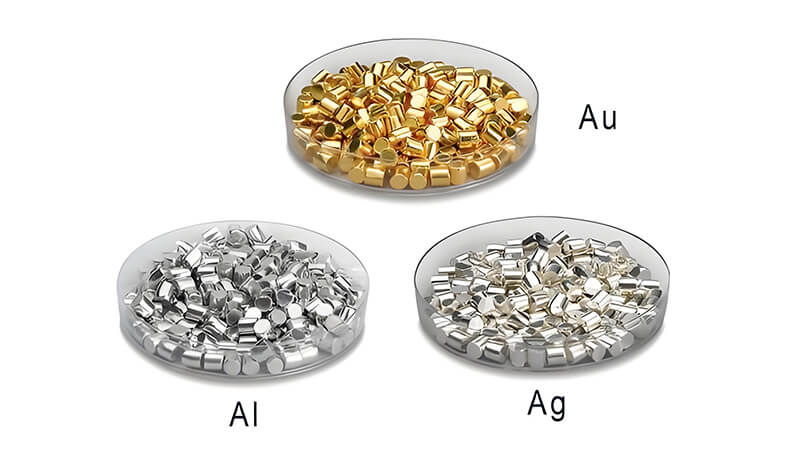
Compared to other deposition methods (such as sputtering), evaporation offers advantages such as faster deposition rates, lower substrate heating, and better film quality.
Types of evaporation materials
We offer a variety of evaporation materials and substrate materials to meet the diverse needs of the industry:
1. Pure metal
Examples include: gold (Au), silver (Ag), aluminum (Al), titanium (Ti), and copper (Cu).
2. Alloy
Examples include nickel-chromium alloys (NiCr) and aluminum alloys (AlCu, AlSi, etc.).
3. Ceramics
Examples include: alumina (Al₂O₃), zirconium (ZrO₂), and silicon dioxide (SiO₂).
4. Evaporation substrate material:
Examples include: Mo crucibles, Cu crucibles, and graphite crucibles.